
FROM FORECAST TO RECOGNISED REVENUE

Revenue recognition that lives where your data does
Armor automates compliant revenue recognition directly inside Salesforce - no exports, no re-keying, no reconciliation chaos.
Certified Compliant
ASC 606
IFRS 15
—
100%
Salesforce Native
—
Zero
External Syncs
—
Real-time
Dashboards
—
1-click
Audit Export
Revenue recognition shouldn't live in spreadsheets
Manual calculations and disconnected tools create errors, audit risk, and late nights - while auditors still lack a clear picture of your deferred revenue.
Without Armor
Revenue managed manually in Excel
Manual, time-consuming audit preparation
Disconnected CPQ and Billing systems
Compliance depends entirely on IT
Approval delays slow financial closes
No single view of performance obligations
With Armor
Native recognition logic across all Salesforce records
Export audit-ready journals in one click
Connect revenue to bookings in a single view
No code, simple configuration rules, treatments, and validations
Legal and Finance visibility inside Salesforce
Faster closes - EOM/Q/Y become non-events
Manual revenue tracking creates risk
Built for Revenue Cloud, Agentforce Revenue Management(RCA/RCB), Sales Cloud & Salesforce Industries - configurable without code, from day one.
Salesforce-Native Architecture
Zero external data syncs. Armor lives entirely inside your Salesforce org, reading contracts, amendments, billing schedules, and POBs directly from your existing data.
Audit-Ready from Day One
Full IFRS 15 and ASC 606 traceability. Version-controlled contract modifications with approval workflows. One-click journal export to your ERP.
No-Code Rule Configuration
Configure recognition treatments for any product type - one-time, recurring, milestone, usage, or bundled - using clicks, not code. No IT dependency.
Contract Version Controls
Every amendment, upsell, cancellation, or extension is tracked with version controls and approval processes. Your audit trail is built automatically.
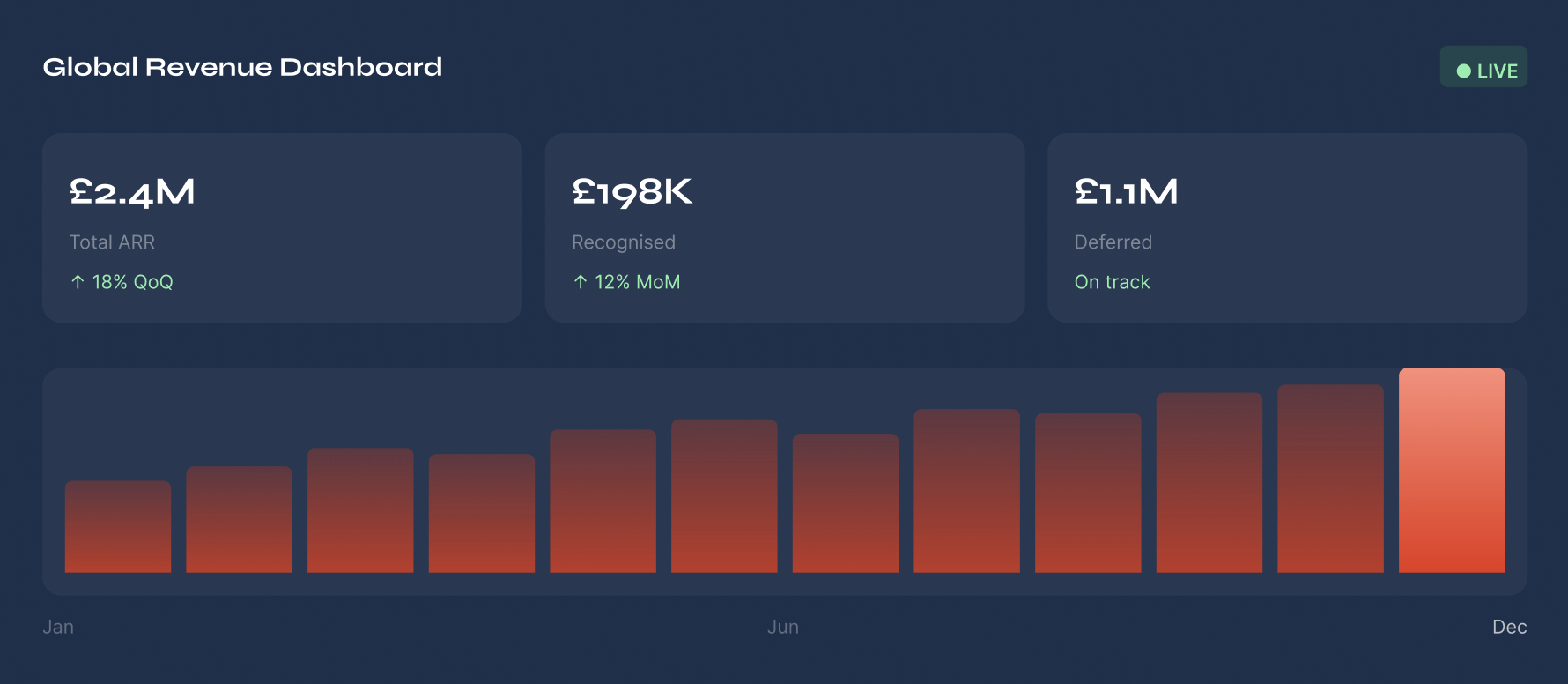
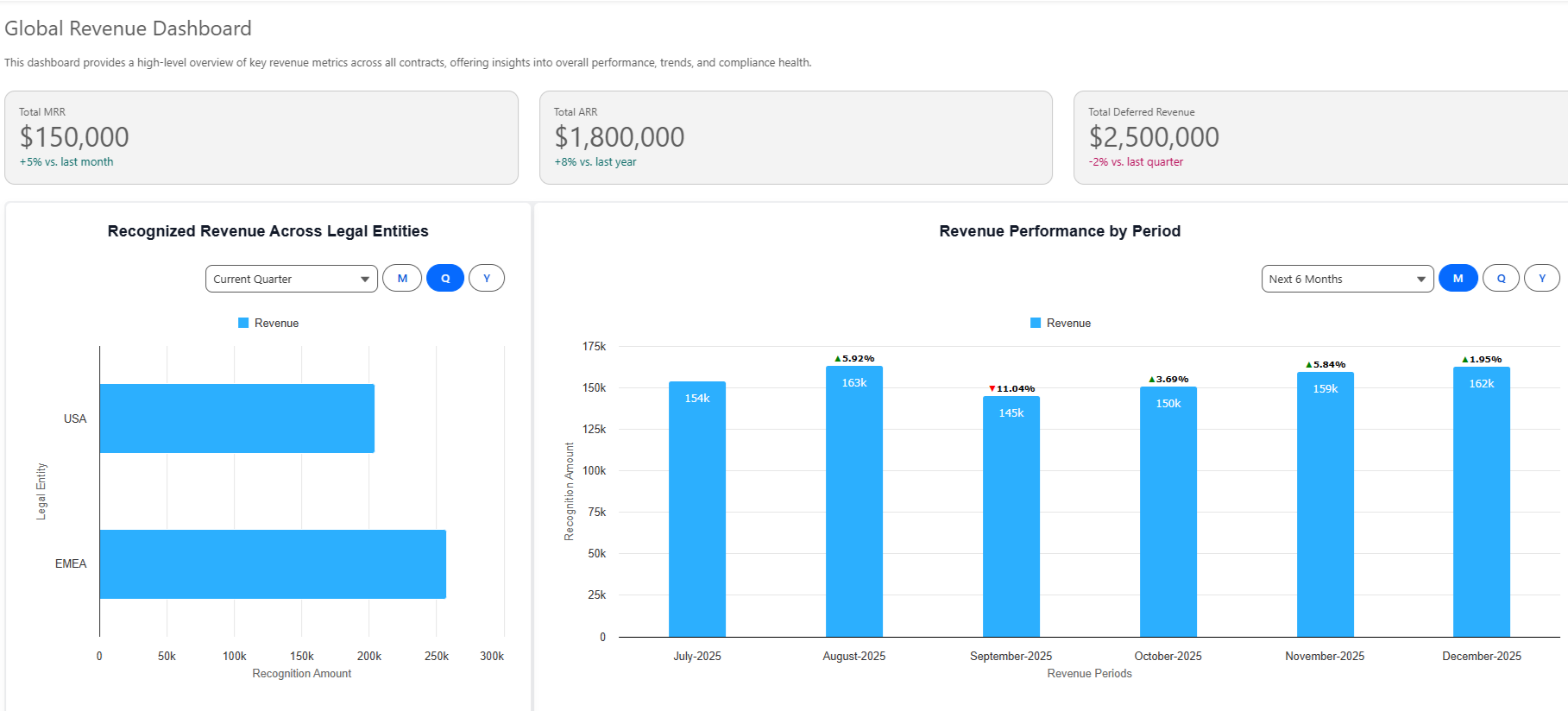
Real-Time Revenue Dashboards
Live journals showing recognised vs. deferred revenue. Drill by customer, product, legal entity, or sales region. Every chart tied to live Salesforce data.
Agentforce Revenue Agent
Summarise Revenue Contracts instantly. Enter a contract identifier to get a full overview and pending actions - powered by Agentforce inside Salesforce.
The 5-step Revenue Recognition Model
Armor automates every step of the compliance framework - from identifying contracts through to recognised revenue and ERP export.
One: Identify Revenue Contracts
Automatically generate Revenue Contracts from any Salesforce object. Unique Contract Identifiers (UCI) intelligently combine future modifications and additions. Full version control with approval workflows.
Rule-based source mapping from Opportunities, Orders, Quotes, Invoices
Contract Activation, Early Termination, and Extension support
Signature validations and amendment controls
Two: Identify Performance Obligations (POBs)
Define POBs for each product based on configurable rules and treatments. Supports all recognition types so complex bundles are handled correctly every time.
One-Time: Recognised on a specific date
Term-Based / Evergreen: Over a fixed or open duration
Milestone: Based on specific dates or events
Usage / Consumption: Based on transaction journal data
Three: Determine Transaction Price
Calculate revenue amounts using Salesforce standard or custom Pricebooks. Handle complex bundled products with Standalone Selling Price (SSP) calculations - custom percentage, equal split, fixed price, or T&M.
SSP Calculator for determining Transaction price
Blended and Extended pricing models supported
Four: Allocate Transaction Price to POBs
Revenue Schedules are generated automatically based on SSP for each POB. Manual adjustments are tracked with version control. Milestone and usage triggers fire automatically on configured events.
Prospective and Retrospective allocation handling
Revenue Waterfall reporting built in
Five: Recognise Revenue
Revenue is recognised in the correct accounting period when each POB is satisfied. Unbilled Revenue (Contract Assets) journals are calculated on Period Close. Export to your ERP in one click.
Month-end journal exports: Amortisation, Milestone, Unbilled, Usage
Journal reversals and period-close automation
Revenue doesn't live in one department. Neither does Armor.
From the finance team closing the month to the IT admin who deployed it - Armor works for every person who touches revenue.
Finance Teams
Faster closes. Fewer errors. Full compliance. Automatic revenue schedules and one-click journal exports end month-end chaos.
Sales Teams
Accelerate deal cycles and align revenue timing with obligations. See exactly how today's bookings impact tomorrow's recognised revenue.
Compliance & Legal
Track every contract change, automate approvals and mitigate audit risk with built-in version control and traceable audit trails
Operations
Sync systems and eliminate reconciliation headaches on one platform, from quote to contract, invoice to recognition.
IT & Admins
No new systems to manage. Native Salesforce deployment with role-based access. Manage with clicks, scale without tech debt.
Real-time intelligence, not stale reports
The moment an order activates in Salesforce, Armor starts generating revenue insights. No manual refresh. No data lag.
MRR, ARR & TCV Live
Track Monthly and Annual Recurring Revenue, Total Contract Value, churn, expansion, and net retention - all updated in real time across accounts, products, and regions.
Customisable Dashboards
Drill by account manager, region, product line, or legal entity. Toggle layouts and add custom metrics - no code, no delays, no IT ticket needed.
Trend Indicators & Forecasting
Spot when performance is improving, flatlining, or dipping. Build forecasts from real-time recognised and deferred revenue data - not spreadsheet guesses.
ERP-Ready Journal Exports
Export accounting transaction journals directly to your ERP - NetSuite, SAP, or any system - with a single click at month-end.
Watch Armor work
From a full product introduction to a quick demo - see exactly how Armor transforms revenue operations inside Salesforce.
Armor Revenue Recognition - Full Introduction
A complete walkthrough of the platform: setup, configuration, POB rules, and the full month-end close process.
How It Works
-
1. Map Your Data
Connect to any Salesforce object: Opportunity, Order, Quote, Invoice, or custom.

-
2. Configure Recognition Rules
Apply smart logic for one-time, recurring, usage-based, or milestone-based revenue.

-
3. Monitor Real-Time Results
Analytics update automatically as data flows in, no spreadsheets, no duplicate reports.
The rules of revenue just changed - permanently
From the finance team closing the month to the IT admin who deployed it - Armor works for every person who touches revenue.
$4.7T
projected AI services revenue by 2028 (IDC)
The world has shifted from selling seats and licences to selling outcomes, credits, and consumption. AI-powered products, agent-based services, and usage-metered platforms have fundamentally broken the assumptions built into traditional revenue accounting.
When a customer buys 10,000 AI credits, when exactly do you recognise that revenue? When the credit is purchased? When it's consumed? When the model returns a result? The answer isn't just a finance question - it's a compliance obligation under IFRS 15 and ASC 606.
Tools built for the subscription era can't keep up. Armor was built for what's next.
AI & Agent-Based Monetization
AI products - from LLM APIs to autonomous agents - are sold as outcomes, not subscriptions. Revenue recognition for these models requires real-time consumption tracking, performance obligation mapping, and period-close logic that traditional tools can't handle.
The RevRec challenge
When is an AI inference "delivered"?
How do you recognise prepaid model credits?
Agent task completion as a milestone event
Multi-model bundle allocation and SSP
Credits & Prepaid Consumption
Credit-based monetization - where customers prepay and draw down over time - has exploded across SaaS, cloud, and AI platforms. Under IFRS 15, unspent credits are deferred revenue until consumed, creating complex waterfall recognition schedules that change with every transaction.
The RevRec challenge
Credit expiry and breakage revenue rules
Drawdown recognition across accounting periods
Top-up purchases modifying existing contracts
Variable consideration and constraint limits
Usage-Based & Hybrid Monetization
Modern SaaS companies layer subscriptions, usage charges, professional services, and one-time fees into a single contract. Each component has its own performance obligation, recognition timing, and SSP. Managing this manually - or in a system not built for it - creates material audit risk.
The RevRec challenge
Separating POBs in multi-element arrangements
Usage estimates and variable consideration
Constraint revenue until obligations are clear
Re-allocate on mid-contract modifications
Built different from the ground up
Most platforms solve pieces of the revenue puzzle. Armor solves all of it! The only proven solution that unifies compliant revenue recognition, real-time analytics, consumption-based forecasting, and native Salesforce architecture -no enterprise complexity, no platform tax.
| Capability | Other Platforms | Armor by ShiftLogic |
|---|---|---|
| Platform | ||
| Salesforce-Native (no separate platform) | ✕ | ✓ |
| No external data sync required | ✕ | ✓ |
| No-code configuration | Partial | ✓ |
| Revenue Recognition | ||
| IFRS 15 / ASC 606 - 5-Step Model | ✓ | ✓ |
| Subscription & One-Time POBs | ✓ | ✓ |
| Milestone-Based Recognition | ✓ | ✓ |
| Consumption / Usage-Based RevRec | ✓ | ✓ |
| AI / Credit-Based Recognition Logic | Partial | ✓ |
| SSP Calculation & Allocation | ✓ | ✓ |
| Contract Modification Framework | ✓ | ✓ |
| Forecasting & Analytics | ||
| Revenue Forecasting (Planned & Unplanned) | Limited | ✓ |
| Consumption Forecast Modelling | Partial | ✓ |
| Real-Time MRR / ARR Dashboards | Separate tool | ✓ Built-in |
| Revenue Waterfall Reporting | ✓ | ✓ |
| Audit & Compliance | ||
| Audit-Ready Journal Export (to ERP) | ✓ | ✓ One-click |
| Version-Controlled Contract Amendments | ✓ | ✓ |
| Agentforce AI-Powered Revenue Agent | ✕ | ✓ Unique |
| Built for Agentforce Revenue Management (ARM) / RCB | Connects via API | ✓ Purpose-built |
Recognize what's been earned.
Forecast what's coming.
Consumption-based businesses need more than a recognition engine - they need to forecast future revenue from current usage patterns, before the period closes.
Consumption-Based Revenue Recognition
Armor's Usage Recognition engine tracks real-time consumption data from any Salesforce object - API calls, compute units, AI credits, seat-hours - and recognises revenue in the exact period the obligation is satisfied, with full journal entry automation at close.
Revenue Forecasting - Planned & Unplanned
Armor generates forward-looking revenue forecasts from your live contract and schedule data. See exactly how much revenue will be recognised in future periods - from active contracts, anticipated renewals, and pipeline deals - without leaving Salesforce.
Consumption Forecast Modelling
For usage-metered products, Armor projects forward revenue by extrapolating current consumption rates across active contracts. Finance teams get a credible, data-backed view of how credit drawdowns and usage charges will land across future periods.
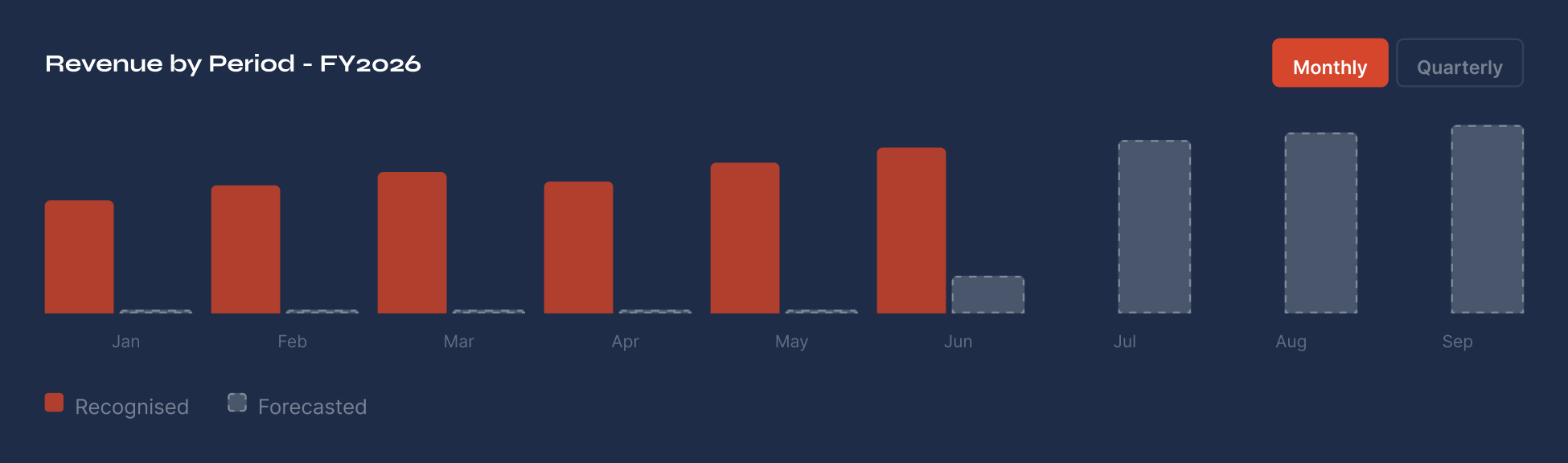
Revenue Waterfall
Live view of recognised vs. forecasted revenue across periods - straight from your Salesforce contract and schedule data.
Unlike standalone forecasting tools
Platforms like Revvana require separate Salesforce-connected forecasting layers. Armor builds revenue forecasting directly from your recognised revenue schedules and contract data - no additional sync, no separate licence, no reconciliation between your RevRec and forecast systems.
Stop Rebuilding Revenue Logic From Scratch
Armor FAQs
-
Armor is a Salesforce-native platform that automates revenue recognition, analytics, and compliance reporting. It applies rule-based treatments directly to your Salesforce data, giving Finance and RevOps teams a single source of truth for recognised and deferred revenue.
-
No. Armor works independently of Salesforce Revenue Cloud. It connects to standard and custom Salesforce objects, including Opportunities, Orders, Invoices, and invoice lines.
-
Yes. Armor is fully configurable to work with both standard and custom Salesforce objects. You can define recognition logic across any object structure, including complex joins, related records, and line-level fields, without writing code.
-
Armor supports time-based, milestone-based, and usage-based recognition models. You can configure rules for one-time fees, recurring subscriptions, or blended treatments across contracts, products, and entities.
-
Yes. Armor supports ASC 606 and IFRS 15 compliance through configurable logic, audit visibility, and rule-based treatment application. It accounts for changes in contract terms, entity-level adjustments, and revenue allocation over time.
-
Yes. Armor tracks all recognition activity at the record level and provides clear, timestamped logs. You can view or export recognition schedules by account, product, period, or entity.
-
Typical configurations are completed in two to four weeks. Setup involves mapping your existing data, applying recognition rules, and validating dashboards. Armor is built for rapid onboarding without complex integration projects.
-
No. Armor is built entirely in Salesforce and uses configuration, not code. Admins, RevOps, and Finance teams can apply recognition logic, build dashboards, and manage updates without developer support.
-
Armor includes dashboards for recognised revenue, deferred revenue, MRR, ARR, churn, expansion, and retention. You can filter by legal entity, owner, region, product, or contract. All dashboards live inside Salesforce and update in real time.
-
Armor runs entirely in Salesforce. Data can be exported or made available via Salesforce APIs for use in ERP systems, BI tools, or financial reporting platforms.
-
Armor offers user-based and enterprise licensing options. Pricing is based on the number of revenue treatments, entities, and Salesforce usage. Contact us to find the right plan for your team.